NEWS & EVENTS
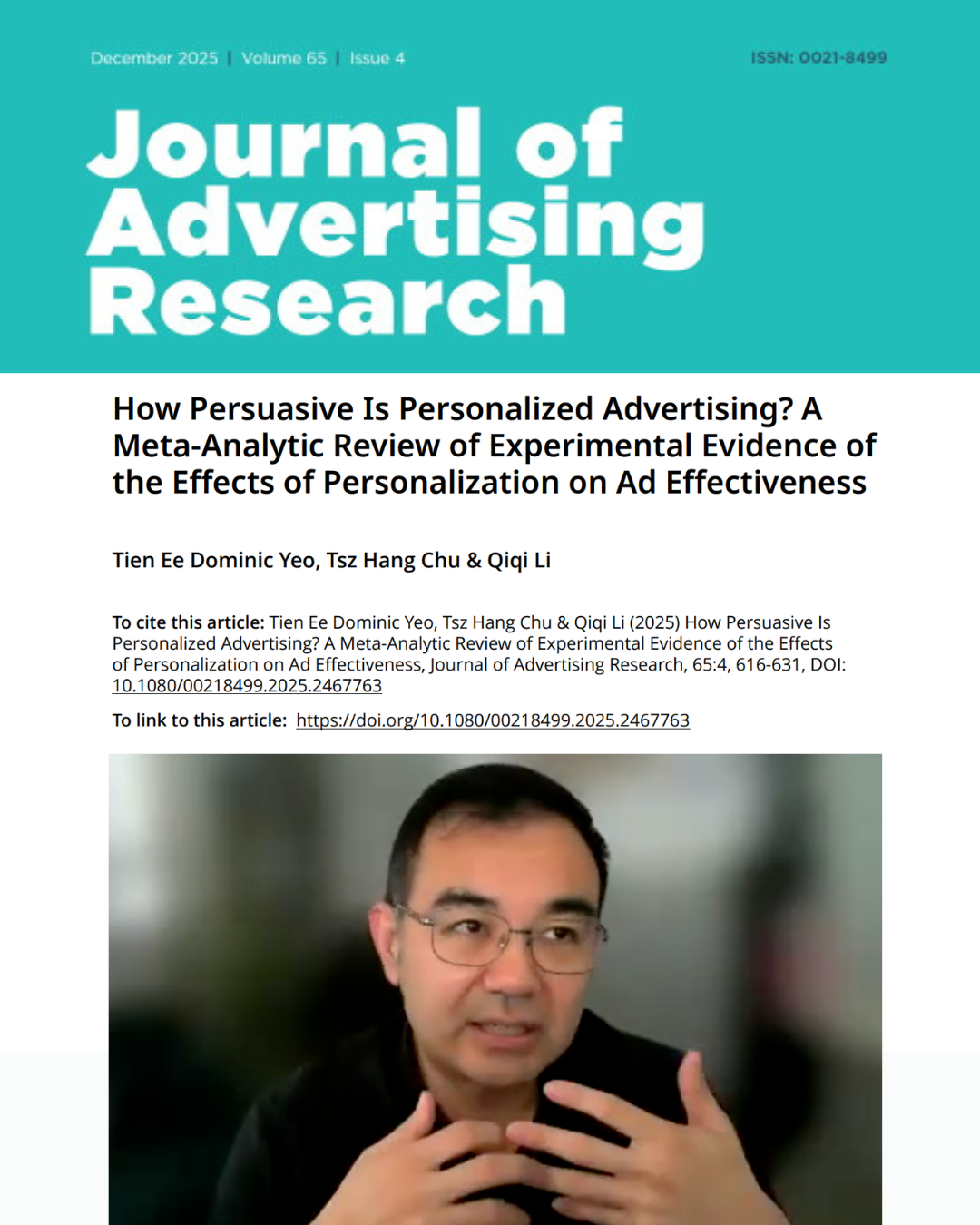
Prof. Dominic Yeo's Paper Named Runner-Up for Best Paper in Journal of Advertising Research
A paper co-authored by Prof. Dominic Yeo, Associate Head and Associate Professor at the Department of Communication Studies, has been named runner-up for the Best Paper Award published in the Journal of Advertising Research (JAR) in 2025. JAR is one of the field's most prestigious recognitions in advertising scholarship. Prof. Yeo co-authored the paper with Dr. Ken Chu, Visiting Assistant Professor at the HKBU School of Communication, and Dr. April Li, a recent PhD graduate of the HKBU School of Communication.
The awarded paper, titled "How Persuasive Is Personalized Advertising? A Meta-Analytic Review of Experimental Evidence of the Effects of Personalization on Ad Effectiveness," draws on a meta-analysis of 53 experimental studies involving nearly 12,000 participants to offer one of the most comprehensive empirical assessments to date of how personalised advertising compares with generic advertising in terms of consumer attitudes and behavioural intentions.
What the Research Found
The headline finding is that personalisation is, on average, more persuasive than non-personalised advertising. Crucially, the mechanism driving this effect is perceived relevance, the sense that an advertisement speaks directly to one's needs and circumstances, rather than any reduction in how intrusive the advertising feels. The data suggest that personalisation does not significantly increase perceived intrusiveness, indicating that the benefit of feeling understood tends to outweigh the discomfort of feeling observed.
The study also identifies important boundary conditions. Personalisation built on real participant data is considerably more effective than scenario-based or imagined personalisation. Additionally, covert personalisation - such as behavioural targeting based on browsing history - tends to outperform overt personalisation strategies, such as the insertion of a consumer's name into an advertisement. The practical implication for advertisers is clear: invest in personalisation, but ground it in genuine relevance rather than surface-level customisation.
Podcast Feature
The research is the subject of a recent episode of the JAR Inside the Research Podcast, in which Prof. Yeo speaks with Prof. Vincent Huang about the study's findings, methodology, and implications for advertising practice. The episode is available on Buzzsprout and YouTube.
The full paper is available at: https://doi.org/10.1080/00218499.2025.2467763